


Counter Drone Technology 101
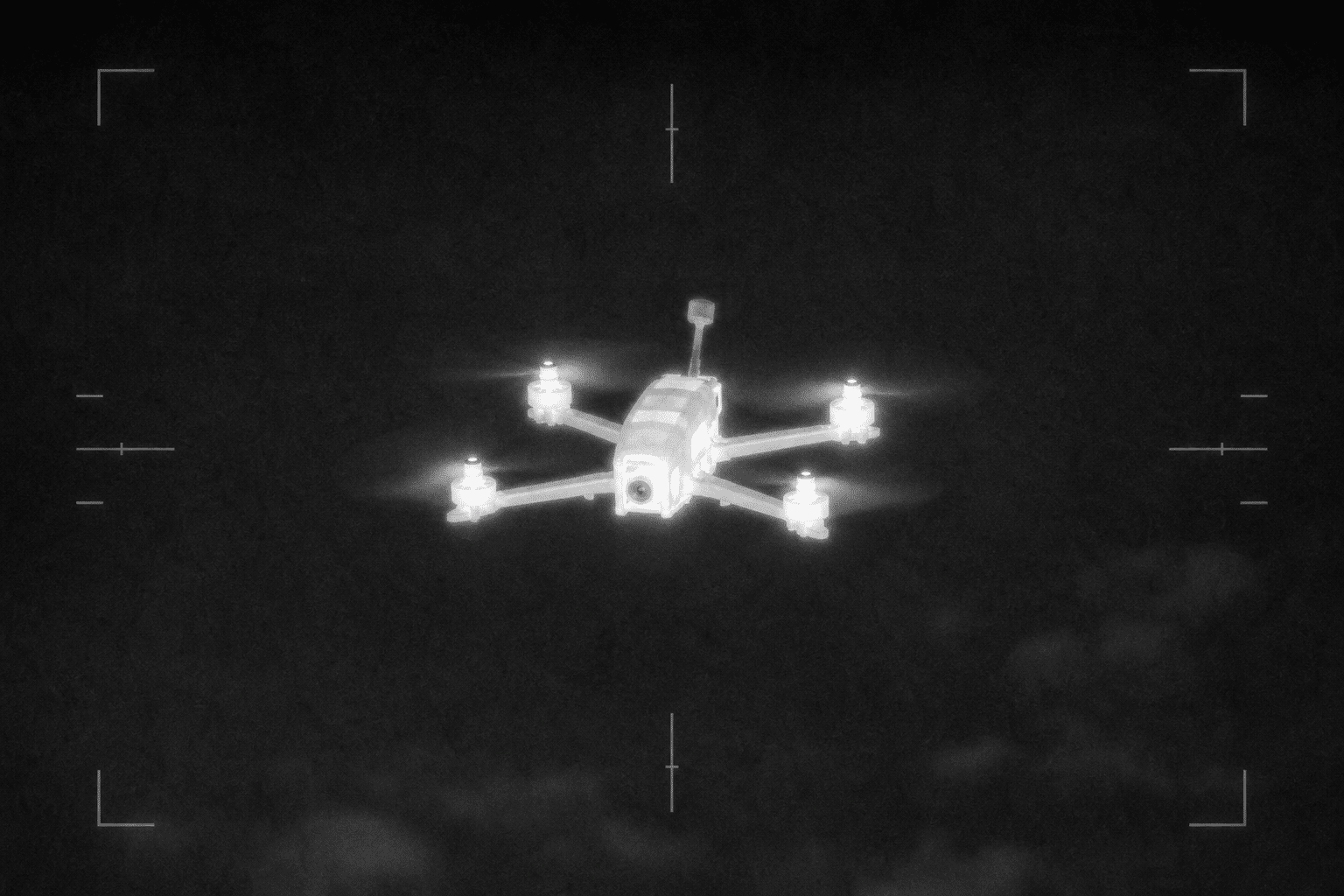
The drone threat has matured faster than most defense frameworks anticipated. What the security and defense communities are dealing with today looks almost nothing like the consumer drone nuisance problem that dominated the early counter-UAS conversation. The platforms are faster, cheaper, more capable, and, in some cases, completely immune to the electronic countermeasures that most counter-drone technology providers still rely on.
Understanding what counter-UAS technology actually does, and more importantly, where it stops working, is the starting point for building a defense that holds up in the real world.
What Counter-Drone Technology Actually Covers
Counter-drone technology is a broad term that encompasses everything from radar systems and RF analyzers to jammers, directed-energy weapons, and kinetic munitions. At the most basic level, it breaks into two functional categories: detection and mitigation.
Detection tells you a drone is there. Mitigation does something about it.
Most articles on US anti-drone technology spend the majority of their time on detection — radar, RF sensors, acoustic arrays, optical systems — and gloss over the mitigation side, or treat it as a footnote. That’s a problem, because detection without reliable mitigation is just an early warning system. It tells you something bad is happening. It doesn’t stop it.
The Detection Side of Counter UAS Technology
Detection is genuinely sophisticated and worth understanding. Modern counter-drone detection platforms typically combine multiple sensor types because no single technology covers every scenario:
Radar provides long-range tracking and works in all weather conditions. Purpose-built drone detection radar uses micro-Doppler technology to distinguish drones from birds and other small moving objects. The tradeoff is cost and complexity; high-quality radar systems are expensive and require trained operators.
RF analyzers passively monitor the radio-frequency spectrum for drone-control signals. They’re relatively low-cost and can sometimes identify the specific drone model and even locate the operator. The hard limitation: they only detect drones that are actively using radio frequency links. A drone flying an autonomous, pre-programmed route, or one controlled via a fiber-optic cable, produces no RF emissions. RF analyzers don’t see it at all.
Acoustic sensors detect the sound signature of drone rotors. They work where other sensors struggle, in ground clutter, around corners, and in environments with limited line of sight. Range is short, often under 500 meters, and they don’t perform well in noisy environments.
Optical and thermal cameras provide visual confirmation and can record evidence for prosecution. They depend on line of sight and degrade significantly in low light, fog, and other poor visibility conditions.
Layering these systems together is the right approach. Each one fills the gaps left by the others. The lessons from drone defense in Ukraine have made this clear: detection platforms that rely on a single sensor type have been exploited repeatedly by operators who understand their limitations.
The FPV Problem That Most Counter-Drone Technology Ignores
Here’s where the standard counter-UAS technology conversation breaks down.
FPV drones — first-person view platforms built for speed, agility, and aggressive flight characteristics — have fundamentally changed the threat calculus. They’re cheap to produce, difficult to track at speed, and have been weaponized extensively in modern conflict. They can be built for under a few hundred dollars, and while field-ready operation typically requires several weeks of training, the barrier to entry is far lower than traditional weapons systems, and dropping fast.
The bigger problem is the subset of FPV platforms that use fiber-optic cables for control rather than radio-frequency links. These drones are completely invisible to RF-based detection and completely immune to every electronic countermeasure in the counter-drone technology toolkit.
No RF analyzer sees them. No jammer touches them. No GPS spoofer redirects them. The control signal runs through a physical cable, and there is no electronic attack surface to exploit.
Defense against fiber-optic drones has become one of the most pressing unsolved problems in counter-UAS right now, and it’s one that most major US anti-drone technology providers aren’t honestly addressing, because their product portfolios don’t have an answer for it. Detection tells you it’s coming. Nothing in their electronic arsenal stops it.
The best answer is kinetic engagement.
Kinetic Drone Defense: The Part Most Articles Skip
Kinetic drone defense is the category that gets the least honest treatment in counter-UAS technology guides. It’s either framed as a last resort, listed in a single paragraph at the end after ten sections on electronic systems, or reduced to a discussion of net guns and interceptor drones.
That framing doesn’t reflect operational reality.
For the threats that electronic countermeasures can’t stop, fiber-optic FPV drones, autonomous systems flying pre-programmed routes without any operator link, platforms hardened against jamming, kinetic engagement isn’t a fallback option. It’s the primary option.
The traditional kinetic answer has been shotguns. The spread pattern helps mitigate some of the accuracy challenges that come with tracking a fast-moving aerial target. But shotgun pellets bleed velocity quickly. The effective range is short. Against an FPV drone moving at speed and altitude, hit probability drops fast, and the energy on impact rarely disables the platform cleanly.
Drone Round was built to solve that problem. Purpose-built 5.56 and 7.62×51 rifle ammunition that delivers multiple projectiles at full rifle velocity, covering more of the drone’s critical systems on impact while maintaining the energy needed to disable motors, sever control links, or destroy propulsion. It’s designed for the rifle platforms that military and security operators already carry, which means no secondary weapon, no additional training requirement, and no change to existing loadouts.
Against a fast-moving FPV drone at distance, rifle-velocity kinetic engagement has a fundamentally different probability of disabling the target than shotgun pellets do.
AI and the Future of Counter-UAS Technology
AI drone defense is the part of the counter-UAS technology conversation that’s moving fastest right now. Machine learning is improving threat classification accuracy, reducing false alarms, and automating response decisions, thereby reducing operator workload and reaction time.
AI-assisted systems can now identify specific drone models from radar signatures and optical feeds, predict flight paths, and coordinate multi-sensor responses in real time. In swarm scenarios, where multiple drones are deployed simultaneously to saturate defenses, AI-managed command and control is no longer a nice-to-have. It’s a requirement.
But AI improves the detection and coordination side of the equation. It doesn’t change the fundamental problem that fiber optic FPV drones present: when there’s no electronic attack surface, you need a physical one.
Special Forces and the Individual Operator Problem
One dimension of the counter-UAS technology conversation that rarely gets addressed in commercial guides is the individual operator problem. Centralized counter-drone platforms, radar arrays, directed energy systems, and integrated command and control are effective when they’re positioned correctly and already operational. They’re not useful to a special forces operator in a forward position who has a hostile FPV drone inbound right now.
The counter-UAS gap at the individual and small-team level is real. Electronic countermeasures at that scale are either ineffective against fiber optic platforms or require specialist equipment that isn’t part of a standard loadout. What every soldier already has is a rifle.
Purpose-built kinetic drone defense ammunition addresses this gap directly, with no additional equipment, no specialist training, and no change to the existing loadout. It works with what’s already in the operator’s hands.
What a Real Counter-Drone Technology Strategy Looks Like
The best drone defense systems aren’t built around a single technology. They’re layered, detection first, then identification, then mitigation, with redundancy at every level so that when one method is unavailable or ineffective, another is ready.
For most threat environments, that looks something like:
- Radar and RF sensors for early detection and wide-area awareness
- Optical and acoustic systems to fill detection gaps and provide visual confirmation
- Electronic countermeasures for the majority of RF-controlled drone threats
- Kinetic engagement capability for fiber optic drones, autonomous systems, and scenarios where electronic methods are off the table
The last point is the one most counter-UAS technology guides either skip or address inadequately. It’s also the one that matters most when the threat is specifically designed to defeat everything else on the list.
The Kinetic Layer That Closes the Gap
Counter-drone technology has come a long way in a short time. Detection is sophisticated. Electronic countermeasures effectively address most commercial drone threats. AI is making the whole system faster and more reliable.
But fiber-optic FPV drones exist; they’re being used in active conflict zones right now, and most electronic defenses in the current toolkit are blind to them. The gap is real. Kinetic engagement closes it.
Drone Round builds purpose-built rifle ammunition for exactly that scenario. Designed for 5.56 and 7.62×51 platforms, engineered for the probability of a disabling hit on a fast-moving aerial target, and deployable with no changes to existing equipment or loadouts.
Learn more about Drone Round’s ammunition, and contact us to discuss where kinetic defense fits in your counter-UAS strategy.